This was supposed to get posted a week and a half ago, but I just had to finish writing the last few sentences:
Initially when I got to Project Reach, I was very timid at meetings. I’d only ask questions to get updated on what people were talking about. I felt it was inappropriate to participate in a discussion in which I had no prior involvement. I figured that every day would get me a little closer to being on board with the rest of the staff. Surprisingly it happened quite suddenly last week.
To protect the dignity and anonymity of the staff I won’t mention their names, but what happened was that power-dynamics and pre-existing staff tensions erupted at a meeting last Thursday, and people ended up shouting, screaming, pointing fingers, making very personal attacks, exposing what other people said, shaking, and crying.
I was just sitting there looking at everybody else, feeling like I needed to say something but then remembering again, that I know close to nothing about people’s deeper histories with each other.
My eyes started tearing up too because I just get really emotional when people who are supposed to get along fight with each other. I felt the same as when my parents shout at each other, recoiling in to an internal fetal position and wanting to yell “why can’t you all just be nice!”
Traumatizing as it may be, it was really a blessing in disguise. After it happened, people were saying things like “welcome to Reach” or “see, now you’ve been initiated”. Not really knowing how to respond, I just kept petting the cat (we have a cat at Reach named Church). Afterwards I did more comfortable at meetings and giving suggestions or even trying to facilitate. I feel good to have become part of the organization so early in the summer. This is not to say, though, that my privileged outsider status is erased. I still feel uneasy trying to facilitate meetings, because I think I continue to represent the intrusive college student who has only had a short history with Reach, whose roots aren’t connected to New York City, and who has more privilege than the staff and the youth participants.
Something that Project Reach stresses, which I brought up in an earlier entry, is the concept that by creating a movement of the victimized and the oppressed (people of color, immigrants, the poor, LGBTQ, differently-able, etc) is unproductive, because it’s not the oppressed that has to change, it’s the oppressors that continue to enforce racism, heterosexism, classism, and the rest. This means that whites must address racism (and the concept of whiteness) in white communities, males must address sexism (and the concept of gender) in male communities, and straight people must address heterosexism in their communities. To be an overprivileged person working to “lift up” or “serve” the underprivileged is both patronizing and colonial in its nature, because it not only undermines the ability of minority communities’ self-determination, it also problematizes the underserved community, not the community and the institutions which have underserved them in the first place.
This made me revisit the model of the CUSP program, where on almost every brochure and webpage it says “serving NYC’s poorest neighborhoods”. This reflects a missionary and patronizing attitude because it emphasizes the class differences between CUSPers and the communities we work with, implies our roles as the smart college students who will lift up the poor, and really is just inaccurate – we are working with very poor communities yes, but not the poorest. We are also working with racially marginalized communities, different gender communities, with extremely well-funded organizations (and many not so well-funded), not to mention medical researchers, not just the economically marginalized.
None of us are doing “traditional” service – scooping food at soup kitchens or singing at nursing homes, and most of us are doing very challenging and important work with very different communities, which only makes me question the tagline even more – why isn’t that part included by “poorest neighborhoods” is? What is the image that CUSP is selling?
I can only speculate why CUSP decided to have such a motto (for funders who have learned a patronizing and missionary view of service? for students who want to relieve their privilege guilt?).
I think there is a lot of value in experiential learning and a lot of good that can come out of this program. Most middle-class liberal students who have progressive ideas have only sheltered views of what it means to be homeless, black, HIV+ and gay. Many students who think working with young people to critically analyze racism and homophobia is really radical and important have never done that before in their lives (like me). So to see it and experience it is transformative and grounding, and I think the program does that part quite well.
Freedom Summer, written by Douglas McAdam, is a fascinating book that I was supposed to read for one of my classes last semester (sorry Dr. Mize). I just finished reading it a week ago (really liked it), and it details the biographies and experiences of privileged Northern white college-students who volunteered to go down South in the summer of 1964 to help register black voters and run the Freedom Schools to teach reading writing and math.
Although our work is hardly comparable to those of the volunteers in Mississippi (who suffered beatings, disappearances, constant threats, and little to no government support), I think the participant-service community dynamic is largely similar, and both CUSP and Freedom Summer emphasizes the value of such experiences for the volunteers. For Freedom Summer Volunteers, their work, the community they built with the southern activists and participants, and the wave of post civil-rights activism they all participated in had changed their entire lives and views in very profound ways, and while they helped the situation in the South, their biggest impact would still be what they brought back to their communities – a more radical political analysis, an understanding of how important community and personal liberation are, and most important of all the tools and strategies of organizing and activism, which has informed generations of activists to this day. Similarly, our biggest impact will be what we learn here and bring back with us to our communities. This summer is just as much about working with (not just serving) marginalized (not just poor) communities (not just neighborhoods) in New York as it is about our personal growth and finding what inspires us that we can bring back to Cornell and our communities to create social justice.
Sunday, June 17, 2007

Saturday, June 9, 2007
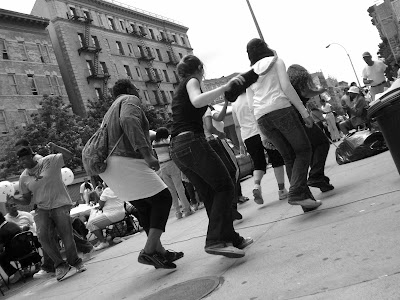
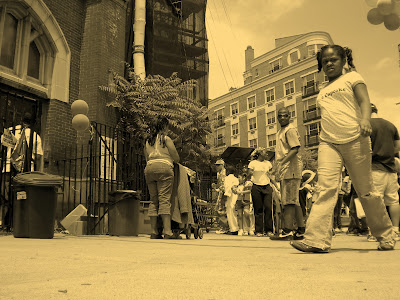
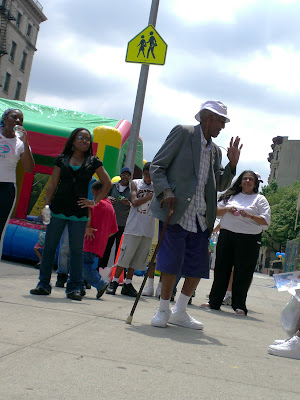
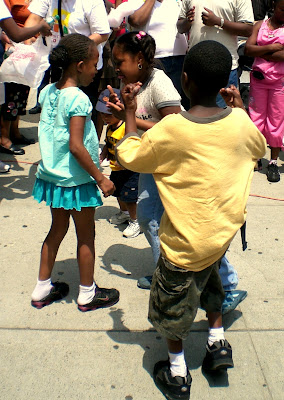
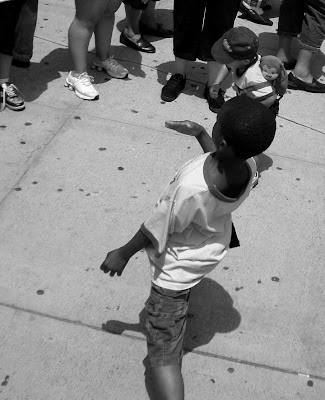
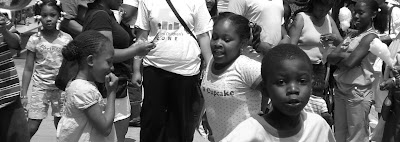
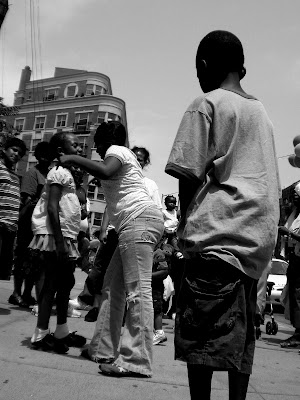
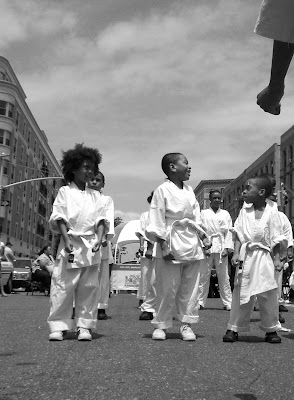
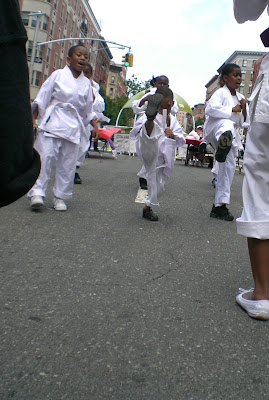
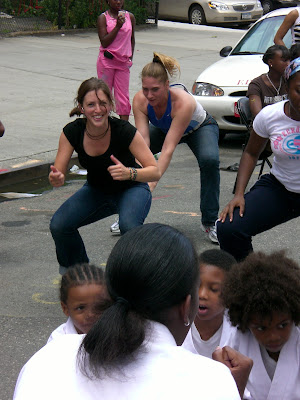
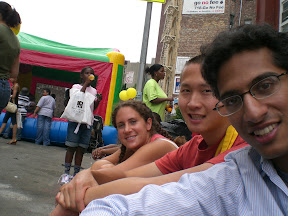
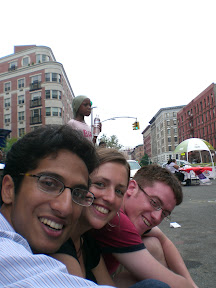
Pictures from TRUCE Block Party
So Harlem Children's Zone's Fitness and Nutrition center did a health fair/block party, and a few of us went to the party. It was very fun and everyone was so friendly and great. And there were some fabulous dancers, intense karate, and moon bounces of every sort.
 |
| From NYC 1 |
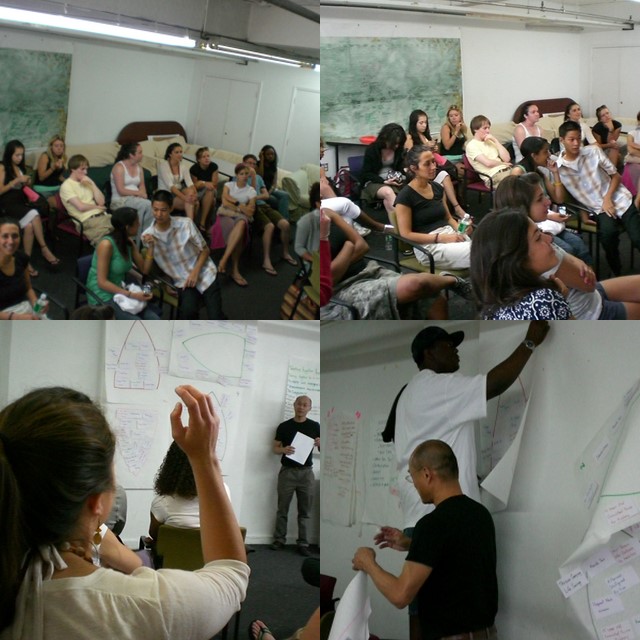
@ Project REACH, during three amazing workshops by Don.
 |
| From NYC 1 |
I think this friday's seminar and workshops impacted a lot of people pretty deeply, or at least I learned a lot from it, and learned a lot about my classmates. Don had us do the boat exercise, which is a lot to explain, but after that he had us line up by race, then by class, and we talked about privilege and how important it was for us to each work in our own communities to achieve social justice.
Some things Don said that are very important:
"Quite frankly, as a person of color, we'll live with or without you [privileged white liberals]"
"We cannot be creating a movement out of victims (the oppressed, the poor, etc). We need to be working from where we do have privilege." So Whites must address White communities, males need to address other males, etc.
Later we had a discussion about heterosexism (heterosexism is a system that places value and privilege on heterosexualism).
Don asked us what our immediate reactions would be if our best friend thought we were gay/lesbian, what our reactions would be if our best friends told us they were gay/lesbian, and another question that I can't remember. Overwhelmingly the responses were quite homophobic and negative, though some people in our group thought that responses like "shocked" and "betrayed" were positive.
I think that for us, privileged students going to an ivy-league school, working on progressive issues and pretending we're tolerant or PC or whatever liberals do, Friday's seminar revealed that we've still got a long way to go.
Friday, June 8, 2007
On the eve of the 90 degree Friday
 Hi, I'm Ding. Here is some information about myself that I will reveal:
Senior Natural Resources major at Cornell
Working @ Project Reach (www.projectreachnyc.org)
Not nearly as good looking as Spanky the gnome
Slightly better eyesight than man in poster.
Project Reach is located in the Lower East Side, and has been there since 1971. Originally formed as a response to the rise of Chinese gangs, they dealt with mainly the young people in the Asian community. In 1985, they were one of the first youth organizations to open their doors to all races. They specialize in empowering youth through anti-discrimination, so that we can overcome racism, sexism, heterosexism, ageism, disability discrimination, classism, militarism, and the list goes on.
Outside of the really amazing workshops they run that raise race/class/sex/gender/orientation/privilege consciousness, they also run a 7-week summer program for young people in the area. This year we may have up to 35 young people from the community working with us. Throughout the summer we will dialogue about the different kinds of discrimination and social injustice, their root causes, how they affect us, and how we can affect change. We'll also be taking trips, going to museums, dance classes, guest lecturers, and doing art projects, flyer campaigns, and murals.
At the end of the summer we'll be out in the Catskills with a coalition of young people from different social justice organizations around the country to engage ourselves at the annual Non-Militaristic Social Justice Boot Camp.
I plan to help them organize the summer program and the boot camp by finding more events/films we can attend and by planning more workshops on empowerment/disempowerment, environmental justice, a people's history of activism, guerrilla art projects. Additionally I will be one of the counselors/mentors for some of the participants, which I can expect to be a very wholesome yet heavy commitment. I can help Project Reach because in a small organization, an extra staff member has a large and measurable effect on the organization. But I feel quite uncomfortable talking about what I can contribute to an organization in a blog. It's too public and self-promoting. Sorry.
-dingbat
Subscribe to:
Posts (Atom)
